
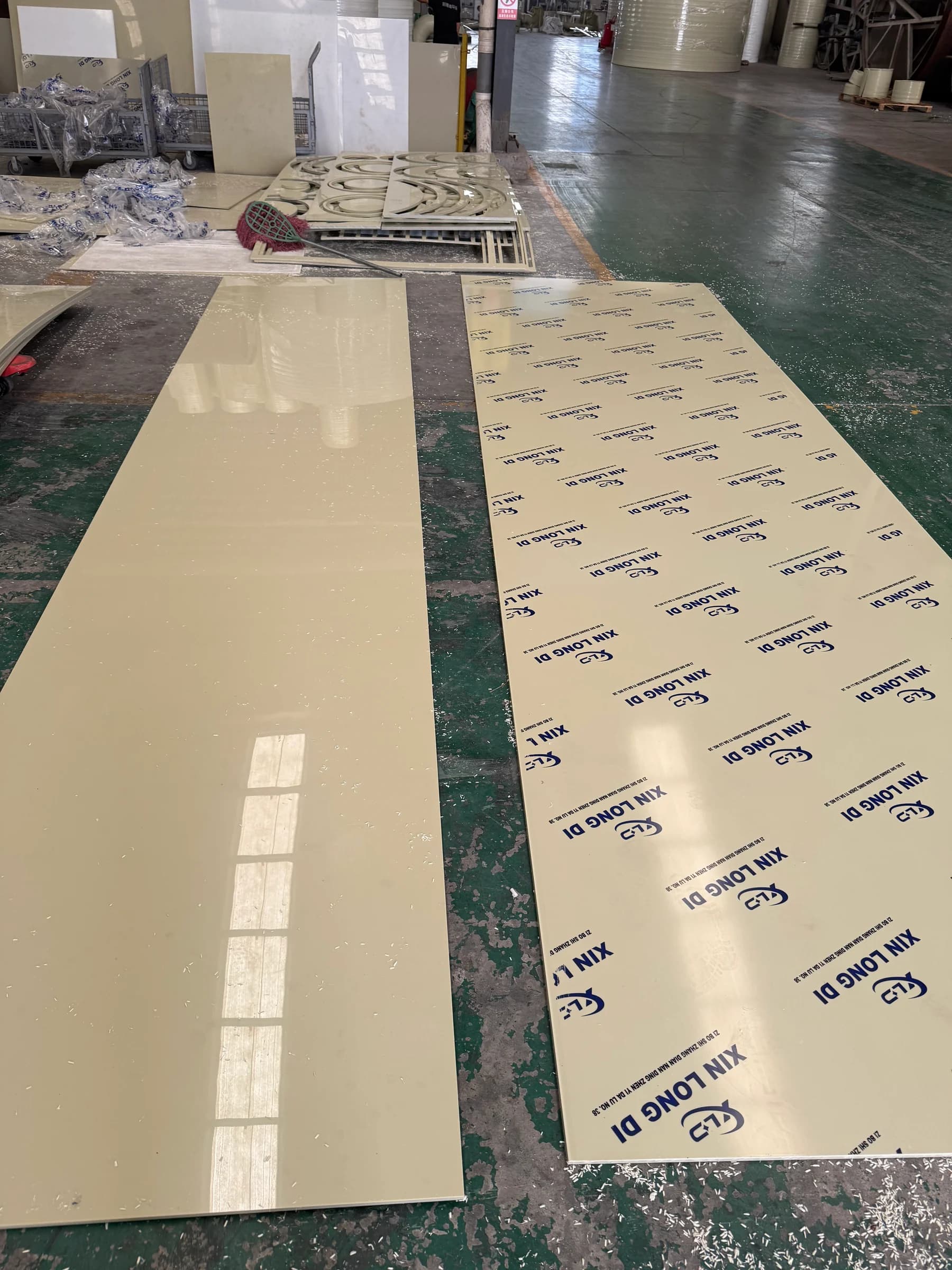
General procurement guidance; not a project-specific design approval.
Start by defining what the liner must do
An RFQ for an “HDPE liner” can describe very different purchases: replaceable panels exposed to moving material, a fabricated liquid-contact lining, or sheets supplied for another contractor to install. State the function and the supply boundary before asking for thickness and price. A sheet quotation alone does not establish the performance of the installed lining system.
This guide helps buyers prepare an industrial liner specification for discussion with a sheet manufacturer. It does not select a grade, design a lining or claim that one HDPE product suits every chemical, wear or containment duty. For XLD’s current manufacturing and cutting scope, see PE / HDPE Sheet.
Separate the material name from the application evidence
HDPE, also written PE-HD, identifies high-density polyethylene. It is not an exact commercial grade. A supplier should identify what material is proposed and which documents describe it. Do not substitute data for UHMW-PE, another polyethylene grade or a different manufacturer’s formulation merely because the materials share the PE name.
Röchling’s water-technology overview gives examples of its PE-HD products in treatment equipment and tank linings. GEHR’s PE-HD page describes its own material and applications. These references establish industry context, not XLD grade equivalence, drinking-water approval, tested wear performance or a service-life guarantee.
If the project calls for a flexible geomembrane, identify that requirement explicitly. Confirm that the proposed product form and installation system match the specification rather than treating every product sold as an HDPE liner as interchangeable.
Build a duty description before choosing the sheet
Separate the information into the conditions at the exposed face and the conditions behind the liner:
- At the face: identify liquids, mixtures, concentrations, cleaning chemicals, solids and the normal and exceptional temperatures. For moving solids, describe the material, contact pattern, impact locations and existing wear observations.
- Behind the liner: describe the substrate, support, existing surface condition, access and any possibility of liquid or gas accumulating behind the panels.
- Across the assembly: explain whether the function requires sealed joints, replaceable panels, penetrations, exposed fixings or a continuous barrier. Give any pressure, vacuum or containment requirement to the responsible designer.
- Around the installation: state indoor or outdoor exposure, installation conditions, inspection access and any regulated-contact requirement that needs specific documentation.
Do not turn a general statement such as “chemical resistant” or “low friction” into an acceptance criterion. Ask which evidence covers the proposed grade and the actual duty. Where suitability is unresolved, the next step is a documented material or engineering review, not an unsupported thickness recommendation.
Break the liner into quoteable panels and interfaces
Provide a dimensioned layout with the drawing revision. Identify each panel, its finished dimensions, quantity, holes, slots, cut-outs and the surfaces that matter in service. Distinguish dimensions of full sheets from those of installed or machined parts. Let the supplier state any proposed cutting allowance instead of assuming a universal allowance.
A practical panel schedule can contain:
- Panel reference and drawing revision.
- Material designation or “grade proposed by supplier, subject to review.”
- Finished length, width and thickness, with required tolerances.
- Quantity and surface requirements for each panel type.
- Edge, opening and interface details, cross-referenced to the installation drawing.
- Documents, identification marks and inspection records requested for that item.
Record the adjoining equipment and fixing concept, but have the responsible designer confirm clearances, movement allowances and support details. Do not copy an old panel’s dimensions without checking whether the replacement must address a changed duty or an installation problem.
Decide who owns the joints and installation details
A liner order can include sheet supply only, cut panels, machined panels or a fabricated assembly. Write down which party will define the joint design, choose joining materials, prepare the substrate, install the liner and perform acceptance checks. Ask the manufacturer to confirm the fabrication work it can actually include.
For welded work, request confirmation of the proposed sheet and welding-material combination and the documents available for that combination. For mechanically retained panels, supply the relevant interface drawings for review. This guide does not prescribe welding settings, fastener spacing or sealing details; those depend on the project and the selected system.
If a performance requirement belongs to the complete lining, agree how it will be assessed and who will provide the evidence. A sheet batch record is useful for material identification, but it is not proof that the installed assembly meets a leak-tightness, structural or wear-life requirement.
Agree evidence and acceptance before the order
Use a sample for a defined question: checking appearance, reviewing a proposed machined feature or carrying out an agreed fabrication trial. Record the sample’s material identity and how it relates to the proposed order. It cannot, by itself, demonstrate long-term performance in the service environment.
Ask for the applicable material data, available batch information and the agreed dimensional or visual inspection record. If special contact compliance or project testing is required, list the specific evidence and resolve availability before order acceptance. XLD’s material document hub distinguishes document requests from published company credentials.
For packing, provide panel references, surface-protection needs, lifting access and unloading constraints. Keep the packing list linked to the panel schedule so the receiving team can identify parts without assuming that similar-looking sheets are interchangeable. Use the existing Purchasing Guide for XLD’s confirmed commercial policies; project-specific scope remains part of the quotation.
Send a liner inquiry that can be reviewed
A useful inquiry can say: “Please review the attached panel layout and duty description for an industrial liner. Identify the proposed HDPE grade, the available supporting documents, the sheet or fabrication scope you can quote, the acceptance checks included and any exclusions. Please list unresolved material or installation questions before confirming the offer.” This is a suggested message structure, not an actual customer order.
XLD manufactures HDPE sheet in-house and offers cutting and drawing-based CNC machining within its confirmed scope; see the HDPE sheet RFQ checklist for the details a quotation needs. It does not follow that a particular lining design or performance requirement has been approved. Use the HDPE sheet inquiry to send the application, panel schedule, quantity and destination. For machined panels, the CNC drawing checklist explains how to identify critical features and inspection conditions.
Sources & scope
Discuss your application
Bring the material, dimensions and operating conditions. We will review the requirements for your project.
Request a Quote