
General procurement guidance; not a project-specific design approval.
Separate the polymer type from the offered grade
A comparison of PPH and “PVC sheet” should first identify which PVC is being proposed. PPH / PP-H is polypropylene homopolymer, a semi-crystalline polyolefin. PVC-U is unplasticised polyvinyl chloride; PVC-C, also called CPVC, is post-chlorinated PVC. Rigid PVC belongs to a different, amorphous polymer family. These distinctions affect which material and processing documents are relevant, but do not approve an application by themselves.
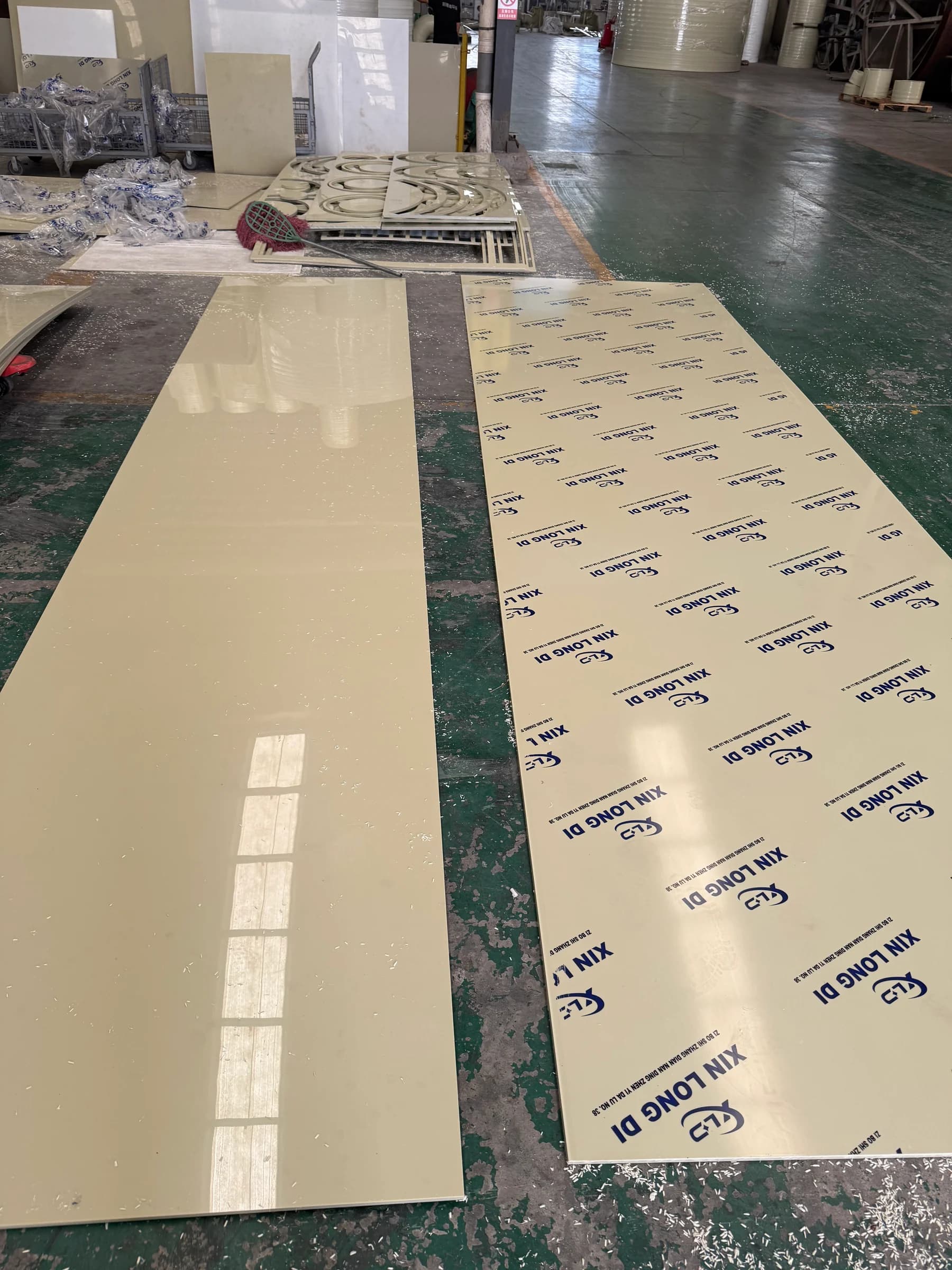
Xin Longdi uses PP sheet and PPH sheet for the same product in its business. Its PPH sheet page and PVC sheet and fabrication page describe the current offering. Availability of PVC-C at XLD must be confirmed; its inclusion in this comparison is not a supply commitment. The existing PVC-U versus PVC-C guide covers designation and substitution checks. This article instead compares PP-H with identified PVC reference products for a project-selection review.
Compare named products with the test methods visible
The table uses Röchling reference products only: Polystone P (Homopolymer) grey extruded, 590977, version 5.0, Trovidur EC N grey, 590994, version 6.0 and Trovidur PHT, 591021, version 1.0. These are not XLD specifications or test results.
On smaller screens, swipe across the table to compare all columns.
| Property or review item | PP-H example: Polystone P | PVC-U example: Trovidur EC N | PVC-C example: Trovidur PHT |
|---|---|---|---|
| Exact product scope | Homopolymer grey extruded sheet reference | EC N grey reference compound | PHT reference compound |
| Density, DIN EN ISO 1183-1, g/cm³ | >0.90 | 1.44 | 1.64 |
| Tensile modulus, DIN EN ISO 527, MPa | >1500 | 3000 | 3000 |
| Notched impact strength, DIN EN ISO 179, kJ/m² | >6 | 4 | 6 |
| Published temperature entry, °C | 0 to 100, long-term Average | −15 to 60, Service Temperature | −10 to 90, Service Temperature; product description states continuous use up to 90 |
| Chemical suitability | Exact grade and service review required | Exact grade and service review required | Exact grade and service review required |
| Joining review | Confirm PP-H sheet/filler system and process | Confirm PVC-U sheet/filler or bonding system | Confirm PVC-C-specific sheet/filler or bonding system |
The source temperature entries use different wording and do not constitute a common loaded chemical-service test. The mechanical entries cite standards without fully specifying specimen conditioning, test temperature and impact-test details here. Preserve the greater-than signs and request equivalent conditions before ranking grades. The manufacturer describes these as informational guideline data, not contractual limits unless expressly agreed. No fire, contact-compliance or other approval is transferred from these products to an XLD order.
Use density, rigidity and impact as separate questions
The reference figures help identify the information a buyer needs, rather than a universal winner. For weight estimates, obtain the actual proposed grade’s density and finished geometry; a lower-bound value is not an exact mass input. For panel rigidity, assess thickness, span, reinforcement, supports, temperature and duration of load instead of converting a tensile-modulus entry into an allowable equipment load.
For impact, give the minimum handling and operating temperature, likely impact locations and relevant assembly details. Notched-impact figures cannot alone establish the behaviour of a welded tank, a drilled mounting point or a complete enclosure. A grade change, formulation change or different specimen condition can invalidate a simple numerical comparison. Have the responsible designer review any proposed substitution against the original duty.
Check chemicals and temperature as one service envelope
Provide the exact media and mixtures, concentration range, contact time, normal and exceptional temperatures, cleaning cycle and mechanical conditions. Röchling’s chemical-resistance guidance makes clear that the medium name alone cannot settle suitability. A general statement about acids, alkalis or salts does not cover every concentration, mixture or operating condition.
The higher temperature entry for the PVC-C example than for the PVC-U example illustrates why “PVC” is too vague for an elevated-temperature inquiry. It does not establish that PVC-C is suitable for the proposed chemical process. GEHR’s PVC-C description likewise distinguishes post-chlorinated PVC from standard PVC-U; product-specific evidence is still needed.
Separate continuous duty from start-up, cleaning and short excursions. Do not use Vicat, heat-deflection or melting data as a universal operating limit. For a chemical storage tank, electroplating vessel or corrosion-exposed environmental-equipment panel, ask which grade-specific evidence and design review address the complete service. These are potential application contexts, not XLD customer case claims.
Match the manufacturing route to the selected polymer
Cutting and CNC machining should be reviewed against the grade, finished drawing, openings, mating surfaces and critical features. Do not assume the same machining setup or acceptance result after changing from PP-H to PVC. Xin Longdi’s fabrication page describes its confirmed cutting, CNC machining, welding and assembly scope; feasibility and tolerances remain subject to the specific project.
For joining, identify the parent sheet, filler or bonding material and the intended method. Hot-gas welding, heated-tool welding and extrusion welding are distinct processes, not interchangeable labels. SIMONA’s welding instructions include material-specific guidance and note restrictions for PVC-U/CPVC extrusion welding that require equipment-manufacturer consultation. They are not XLD welding settings or proof that every method is offered for every grade.
Do not assume PP-H can be welded directly to PVC-U or PVC-C. Where a design needs unlike materials to meet, request an engineered interface and clear responsibility for its selection and acceptance. For a proposed bonded PVC joint, have the responsible supplier confirm the complete material and joining system for the service; a generic “PVC adhesive” description is insufficient.
Buyer questions before material approval
Does a higher temperature entry make PVC-C the best choice?
No. Confirm chemical compatibility, mechanical duty, joining requirements and the exact grade together. A supplier’s reference temperature entry does not approve the material for a loaded chemical vessel, and PVC-C supply at XLD must be confirmed separately.
Is PVC-U an automatic substitute for PP-H at room temperature?
No. Room temperature removes only one question. The chemicals, concentrations, contact time, structural design, joining system and inspection requirements still need review. Submit the original specification and request an explicit explanation of any proposed substitution.
What documents should accompany a comparison quotation?
Ask for the exact proposed commercial grade, current technical data sheet, applicable chemical-resistance evidence and available order-specific inspection or material documents. Identify any required standard or acceptance condition in the RFQ and obtain confirmation of availability; do not assume a reference manufacturer’s certification applies to XLD material.
Request a quotation that exposes differences
For each candidate, request the exact sheet designation, manufacturer or commercial grade, product form, current data sheet and available order-specific documents. State dimensions, quantity, surface and tolerance requirements, drawing revision, supports, operating duty, fabrication scope and destination. Identify any required inspection, joining or compliance evidence and confirm availability before order acceptance.
Ask the supplier to list substitutions, assumptions and exclusions separately. If the project specifies PVC-U, a proposed PVC-C or PP-H alternative needs approval rather than silent acceptance as an upgrade. If the chemical or structural review remains open, hold that decision instead of selecting from an isolated property number.
Submit the package through the PPH sheet inquiry or PVC sheet inquiry. The Purchasing Guide covers the existing commercial process; the proposed grade, documents and manufacturing scope must be confirmed in the quotation.
Sources & scope
Discuss your application
Bring the material, dimensions and operating conditions. We will review the requirements for your project.
Request a Quote