
General procurement guidance; not a project-specific design approval.
Start with the service, not a sheet thickness
PPH sheets can be considered for fabricated chemical storage tanks and corrosion-exposed equipment. The designation PPH, also written PP-H, identifies polypropylene homopolymer; it does not identify an exact commercial grade or approve a tank for a particular chemical. Xin Longdi uses PP sheet and PPH sheet for the same product in its business. See the PPH sheet page for the confirmed supply scope.
For a buyer, the first task is to assemble the operating conditions and give the responsible designer enough information to assess the proposed material and vessel. This guide focuses on sheet selection and the handover to fabrication. The separate extrusion-wound PPH tank guide explains Xin Longdi’s confirmed winding process; an extruded wound body and a sheet-built assembly should not be assumed to have the same wall construction.
Describe all media that will touch the equipment
A useful material review identifies the exact medium and conditions rather than asking whether “PPH is chemical resistant.” Röchling’s chemical resistance guidance identifies concentration, exposure time, temperature and mechanical loading among the factors to review. Its guidance is general industry context and is not a test result for an XLD grade.
Provide the designer and material supplier with:
- Stored or processed medium: names, composition and concentration range, including relevant mixtures or contaminants.
- Operating cycle: normal and exceptional temperature, duration of exposure, filling and emptying cycles, and any change in conditions during operation.
- Cleaning: cleaning chemicals, their concentrations, temperature and frequency, including any rinse that changes the exposure.
- Other surfaces: vapour, condensate, splashes or external contact where relevant, rather than only the liquid in the main chamber.
- Mechanical and environmental conditions: support, loading, indoor or outdoor location, weather exposure and any fire or electrical requirement that needs separate evidence.
Mark missing values as open questions. Ask the supplier to identify the proposed sheet grade and the data or compatibility information available for those conditions. If the proposed grade or application remains uncertain, resolve it with the responsible material specialist before approving the order. A general resistance chart, an image of a tank or a material-family name cannot establish suitability for the complete duty.
Give the designer the information needed for wall and support review
The right sheet thickness depends on more than the volume of the vessel. Identify the geometry, liquid levels and density or other load information, support arrangement, openings, connected piping and equipment loads. State normal and exceptional pressure or vacuum conditions, if any, and provide the installation location and project design basis. The responsible designer must determine the applicable design, reinforcement and acceptance criteria.
Thermoplastics can deform under sustained load; their behaviour depends on time and conditions. SIMONA’s technical handbook discusses long-term behaviour and structural review for its materials. It is not an XLD tank calculation and does not provide a universal PPH wall thickness.
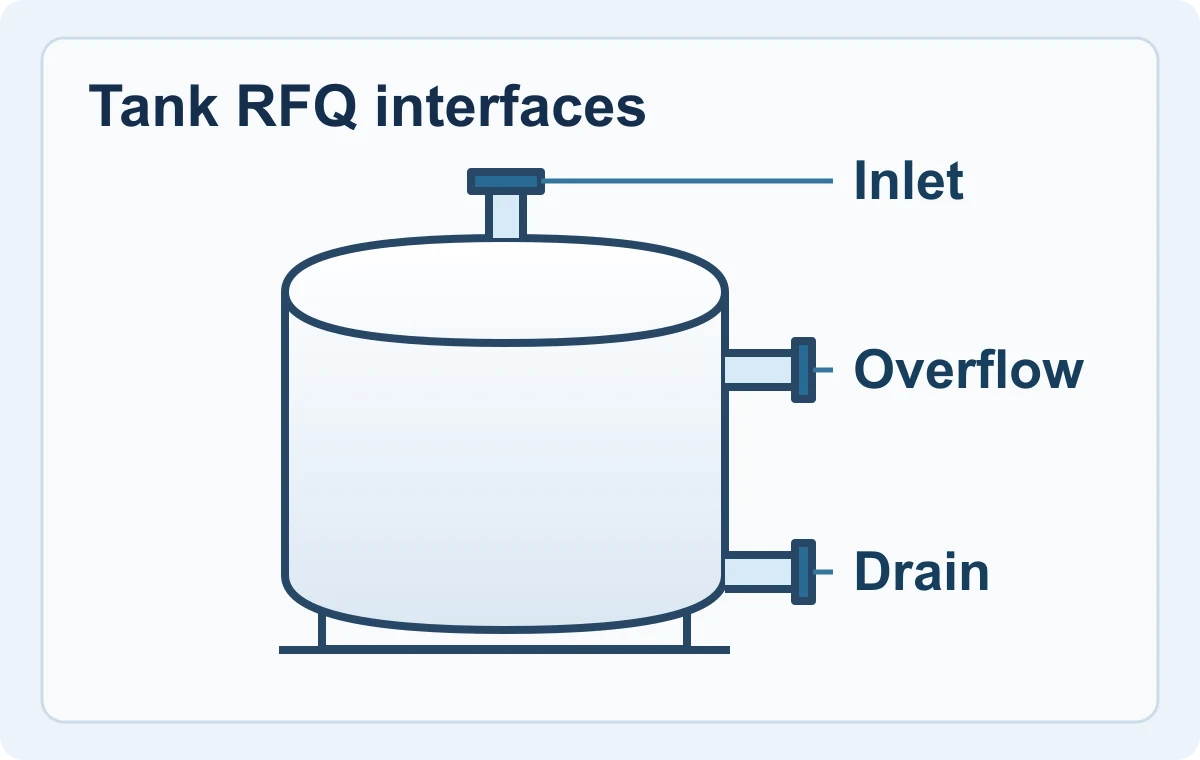
Send the proposed tank drawing with the dimensions that are fixed and those open for review. Identify the location of inlet, outlet, vent and access openings; the number and orientation of connections; and loads that may be transferred by adjacent piping. For a rectangular assembly, indicate the intended support or reinforcement interfaces. For a cylindrical or wound tank, ask the supplier to identify the actual body and end construction in the quotation. Do not infer a pressure rating or an allowable load from a photograph or sheet thickness alone.
Specify fabrication and welding responsibilities
Separate the supply of PPH sheet, cut panels, welded components and a complete tank in the RFQ. Request confirmation of the intended sheet grade and joining-material combination, the drawing revision and which party owns the welding procedure, inspection and final design acceptance. Provide openings, mating details and site constraints before the fabrication scope is agreed.
SIMONA’s welding instructions are material- and process-specific. Their settings are not XLD production parameters and should not be copied into an order for an unidentified grade. Ask the fabricator which documented procedure and relevant checks are available for the proposed materials. The welding rod selection guide provides a practical pairing record.
For quality control, agree what will be checked and recorded before production: material identification, critical dimensions and interfaces, visible joint criteria, any agreed testing and the documents to accompany delivery. A visual inspection, material document and a complete equipment test answer different questions. Availability and scope of each record must be confirmed for the order; no test, certification or pressure rating is implied by this article.
Prepare a reviewable PPH tank RFQ
Use one item reference and drawing revision for each tank or sheet-built component. Include:
- Material designation and proposed grade, or a request for the supplier to identify the grade for review.
- Medium, concentration, operating and cleaning conditions, with unresolved values marked clearly.
- Vessel or component geometry, working levels, required dimensions, support and reinforcement interfaces.
- Nozzle schedule, connected equipment, access, installation location and any stated pressure or vacuum duty.
- Supply boundary: sheets, cut panels, welded assembly or complete equipment; state who designs, installs and accepts it.
- Quantity, destination, delivery constraints, packing expectations and the requested drawings, inspection or material documents.
Custom PPH Tank RFQ Checklist
On smaller screens, swipe across the table to compare all columns.
| Category | Information to send |
|---|---|
| Tank dimensions | Diameter or length and width, overall height, working volume and maximum liquid level. |
| Stored medium | Chemical name, composition, concentration range and liquid density at relevant conditions. Include cleaning media and mixtures. |
| Operating conditions | Normal and upset temperatures, exposure duration, and atmospheric, positive-pressure or vacuum duty. State gauge values and units where applicable. |
| Flanges and nozzles | Nominal size, mating standard and designation, location, orientation and quantity. Include the nozzle schedule or mating drawing. |
| Seals | Proposed gasket material, media and temperature at the seal, and any compatibility evidence or open questions. |
| Drain | Outlet location and size, valve connection, clearance and any residual-liquid or cleanout requirement. |
| Overflow | Outlet location and elevation, size and downstream connection requirements. Identify the vent separately. |
| Installation | Indoor or outdoor site, foundation, support arrangement, access and loads from connected piping. |
| Technical documents | CAD files, revision-controlled PDF drawings, duty specification, project design requirements and agreed acceptance criteria. |
Agree the flange standard and mating details before releasing the drawings. A nominal size alone does not establish the bolt pattern or sealing face. Confirm the gasket separately against the media and temperature at the joint. Mark drains, overflows and other openings on the same drawing so the fabricator can assess clearances, joint access and clashes with supports or reinforcement. Have the responsible designer review wall thickness and reinforcement for the actual geometry, liquid loads, pressure or vacuum, supports and service conditions before fabrication. For a change to an existing tank, use the material review for changed duty to record the revised conditions and outstanding approvals.
A useful inquiry could say: “Please review the attached duty description and drawing for a PPH chemical tank. Identify the proposed sheet grade, fabrication scope and available material and inspection records. List assumptions and unresolved compatibility or design questions before confirming the offer.” This is an illustrative request, not a customer project.
Start with the PPH sheet inquiry for material supply, or request a tank quotation for an assembled vessel. The Purchasing Guide covers the existing commercial process; project-specific terms and technical scope are confirmed in the quotation.
Sources & scope
Discuss your application
Bring the material, dimensions and operating conditions. We will review the requirements for your project.
Request a Quote